
Pruning
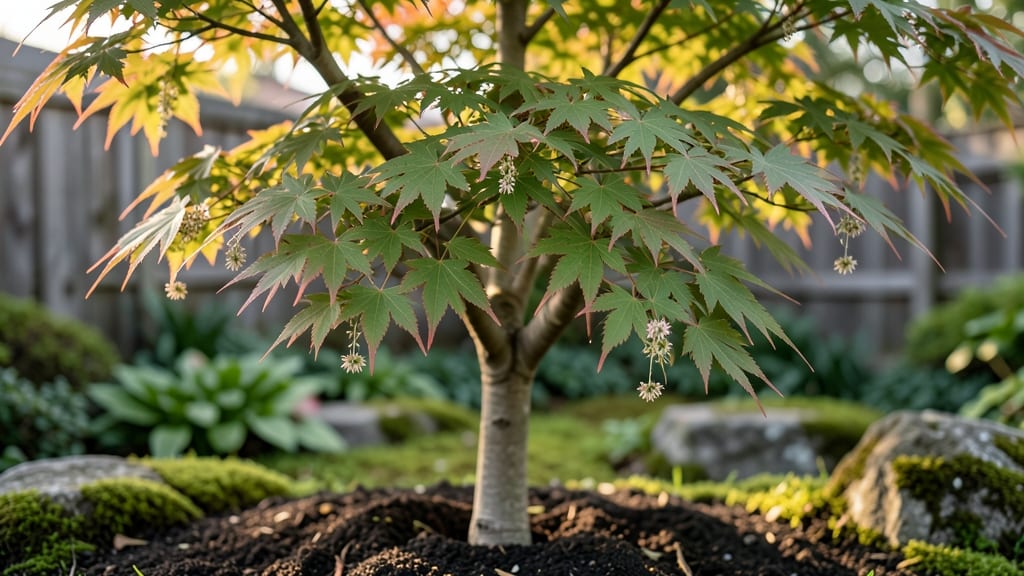
The shapes of this Japanese maple leaf vary dramatically by cultivar—from bold, deeply cut lobes in 'Bloodgood' to finely serrated edges in 'Emperor I'—and can be further refined through strategic pruning techniques.
The diversity in Japanese maple leaf shape stems from genetic variations between cultivars, where some develop dramatic palmate lobes while others maintain simpler serrated edges. 🌿 For example, the 'Shishigashira' cultivar features fan-shaped leaves with delicate, almost feather-like divisions, whereas 'Drummondii' showcases more rounded, less intricate forms.
These differences aren't just aesthetic—they influence how each tree responds to pruning and environmental conditions.
Understanding your specific cultivar is key because pruning methods vary significantly. Aggressive trimming on a 'Bloodgood', for instance, can alter its natural lobed structure over time, while more delicate varieties like 'Emperor I' require gentler techniques to preserve their fine details.
Seasonal timing also plays a role—pruning too late in the year might stimulate unwanted growth that could distort leaf development.
💡 In This Article
- How Japanese Maple Cultivars Define Unique Leaf Shapes
- Pruning Techniques to Enhance or Modify Leaf Structure
How Japanese maple cultivars define unique leaf shapes
The leaf architecture of Japanese maples is primarily determined by their genetic lineage, which dictates whether they develop palmate (hand-like) or pinnate (feather-like) structures.
For instance, the 'Bloodgood' cultivar exhibits dramatic 7-9 deeply cut lobes radiating from a central point, while 'Emperor I' features 11-13 finely serrated leaflets arranged in a pinnate pattern.
These differences stem from variations in the axillary bud development during the tree's growth phases, where more buds create deeper lobes and fewer buds result in smoother edges.
Climate plays a surprising role in leaf morphology too. Cooler northern climates often produce smaller, more compact leaves with tighter spacing between lobes, as seen in 'Shishigashira' (with its 10-12 delicate divisions per leaf).
Conversely, southern varieties like 'Drummondii' develop broader, less intricate leaves (typically 5-7 lobes) due to longer growing seasons that encourage more aggressive cell division. The pH levels of the soil also influence color intensity—acidic soils (pH 5.0-6.0) enhance the vibrant reds and oranges seen in autumn foliage.
What most gardeners overlook is how these shapes affect the tree's overall health.
Cultivars with deeply lobed leaves like 'Bloodgood' are more susceptible to wind damage because their larger surface area catches more airflow, while varieties with tighter leaf structures like 'Emperor I' handle urban environments better due to reduced exposure.
This is why landscape designers often pair 'Shishigashira' (delicate, 12-inch-wide leaves) with protected garden spots rather than exposed courtyards.
The science behind these variations lies in phyllotaxy—the arrangement of leaves on stems. Most Japanese maples follow an alternate spiral pattern, but the angle between leaves (called the phyllotactic angle) differs by cultivar.
For example, 'Bloodgood' leaves emerge at approximately 137.5 degrees (the golden angle), while 'Drummondii' uses a slightly wider 150-degree angle, creating a more open canopy. This subtle difference affects how sunlight penetrates the tree, influencing both leaf shape and autumn color development.
Consider this visual comparison: A 'Bloodgood' leaf at maturity measures about 3-5 inches wide with lobes extending 1-2 inches beyond the central stem, while a 'Emperor I' leaf remains 2-3 inches wide with serrations only 0.5 inches deep.
The contrast isn't just about size—it's about the structural integrity of each leaf type. 🌿 Understanding these nuances helps you select cultivars that match both your garden's climate and your aesthetic preferences while ensuring the tree thrives.
For those curious about hybrid possibilities, some modern cultivars like 'Green Cascade' combine elements of both leaf types, featuring 7-9 shallow lobes with serrated edges—a middle ground that demonstrates how selective breeding can intentionally merge desirable traits from different parent varieties.
This blending shows how much control we have over leaf morphology through careful cultivation techniques.