
Pests and Diseases
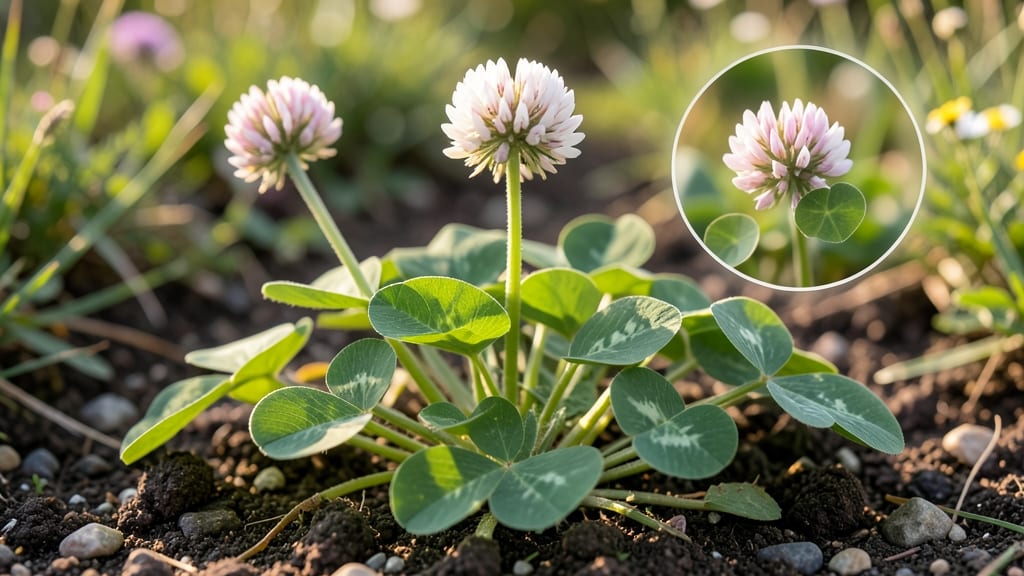
Yes, there is such a thing as a four-leaf clover, existing as a natural genetic mutation of the common three-leaf shamrock, appearing in roughly 1 in 10,000 plants.
These rare botanical oddities aren't a separate species but rather a spontaneous genetic quirk in Trifolium repens, the scientific name for white clover. 🌱 The extra leaf forms when a specific homeotic gene malfunctions during development, causing the plant to produce an additional leaflet.
While some legends claim finding one brings luck, scientists explain their rarity stems purely from probability—no magical properties are involved, just a fascinating twist of nature's genetic code.
Fun fact: The odds of spotting one naturally are about the same as rolling a double six with dice, making them a true gardener's treasure. If you're curious about growing your own, focus on healthy clover patches in well-drained soil during spring or early summer when growth is most active.
💡 In This Article
- The Science Behind Four-Leaf Clover Mutations
- How to Increase Your Chances of Finding a Four-Leaf Clover
The science behind four-leaf clover mutations
The extra leaf in a four-leaf clover stems from a fascinating genetic hiccup called a homeotic mutation. In most white clovers (Trifolium repens), three leaflets form from a single leaf bud due to precise genetic instructions.
However, when a specific gene—often linked to leaf development—malfunctions, the plant produces an additional leaflet. This isn't a disease or pest damage; it's purely a random genetic variation that occurs during cell division in the growing tip.
Researchers estimate these mutations happen in about 1 in 10,000 clovers, making them rarer than finding a white four-leaf clover (which occurs in roughly 1 in 10,000 of the already rare four-leaf clovers).
The extra leaf typically grows from the center, creating a symmetrical pattern. Unlike other plant mutations—like variegated leaves or extra petals—this one doesn't affect the plant's survival, so it persists in nature. 🌱
Environmental factors can slightly influence mutation rates. For example, clovers grown in well-drained, nitrogen-rich soil with moderate sunlight tend to have healthier growth, which may increase the chances of spotting mutations.
However, the primary driver remains pure genetic chance. Unlike cultivated plants (like roses or orchids), clovers haven't been selectively bred for extra leaves, so these mutations remain a wild, unpredictable phenomenon.
Some people wonder if four-leaf clovers are a separate species, but they're not. They're still Trifolium repens—just a botanical curiosity. The mutation doesn't change the plant's reproductive cycle, pollination, or seed production. It's like finding a human with an extra finger: a fascinating anomaly, but not a new species.
Scientists classify them as a somatic mutation, meaning they don't get passed to offspring unless the mutation occurs in reproductive cells (which is extremely rare).
Comparing rarity, four-leaf clovers are about as common as finding a blueberry with five seeds instead of one. In nature, most mutations don't provide a survival advantage, so they don't spread. The four-leaf trait is neutral—neither harmful nor beneficial—which is why it persists at such low frequencies.
Some gardeners have tried propagating four-leaf clovers by taking cuttings, but the mutation rarely carries over to new plants. 🌿
What makes this mutation so intriguing is how it challenges our understanding of plant genetics. While most mutations are harmful, this one is harmless and visually striking. It serves as a reminder that nature's "mistakes" can sometimes create the most fascinating surprises.
If you're lucky enough to find one, you're witnessing a tiny, temporary rebellion against the plant's usual three-leaf design.