
Pruning
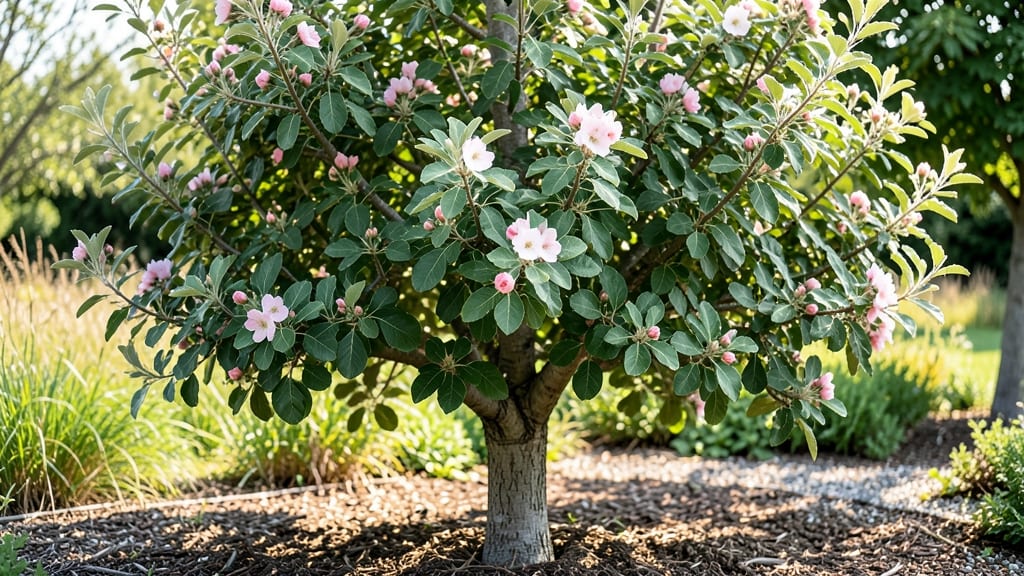
That first crisp leaf in your hand can help you identify an apple tree by leaf—a simple way to unlock the secret of your backyard tree. 🍏 Apple trees reveal their varieties through subtle leaf clues—shape, veins, and edges that tell you whether you’ve got a sweet Honeycrisp or a tart Granny Smith waiting in the branches.
The key is looking at three things: leaf shape (oval to oblong), vein patterns (prominent or fine), and edge texture (smooth, serrated, or lobed). A Honeycrisp leaf is broad with jagged teeth, while a Fuji’s is narrower with softer edges.
Even the way veins fan out differs—some spread wide, others stay tight.
You’ll spot the differences in just a few minutes, and suddenly your tree’s identity becomes clear. No more guessing which variety produces those perfect fall apples. Grab a notebook and compare your finds to common varieties—you’ll be an expert by lunch.
This works for backyard trees, orchards, or even wild apples. Once you train your eye, you’ll recognize them anywhere. The best part? No tools needed—just your curiosity and a little sunlight.
Nature’s Leaf Design Tricks
Apple trees don’t just grow leaves—they evolve them based on genetics, environment, and survival strategies. Understanding why leaves vary in shape, texture, and vein patterns helps you decode the tree’s identity. Here’s the science behind those leafy clues:
Every apple tree variety carries a unique genetic code that dictates leaf morphology—think of it as nature’s fingerprint. For example:
- Serrated edges (like Granny Smith) often signal compact, disease-resistant genes, while smooth lobes (like Honeycrisp) may indicate faster growth but higher susceptibility to pests.
- Leaf size ties to fruit production: Smaller leaves (e.g., McIntosh) often mean smaller apples but quicker maturation, while larger leaves (e.g., Fuji) suggest bigger fruit but slower energy storage.
- Vein thickness reflects water transport efficiency—thicker veins (common in Gala) help trees thrive in dry climates, while finer veins (like in Pink Lady) adapt to humid regions.
Actionable tip: Cross-reference leaf traits with a USDA apple variety database to narrow down matches. For instance, serrated + glossy = likely Golden Delicious heritage.
Leaves aren’t static—they change in response to sunlight, water, and temperature. Here’s how:
| Factor | Leaf Response | Example |
|---|---|---|
| Low light | Larger, thinner leaves with paler veins to maximize light absorption. | A Jonathan apple tree in shade may develop broader leaves than one in full sun. |
| Drought | Smaller, curled or leathery leaves to reduce water loss. | Arkansas Black trees in dry summers often show crinkled margins. |
| Cold snaps | Reddish or purple hues (anthocyanins) to protect cell damage. | Young Cortland leaves may flush purple in spring frosts. |
Pro tip: 🌡️ Compare leaves from different exposures on the same tree—sunny vs. shady sides can reveal hidden clues. For example, braeburn leaves are darker green in sun but lighter green in shade.
Not all leaf differences are natural—some are forced by invaders. Here’s how to spot the culprits:
- Mites or aphids:
- Cause yellow stippling (tiny white dots) or curled edges.
- Common in Red Delicious trees; check undersides for webbing.
- Fungal infections (e.g., apple scab):
- Produce oily, dark spots with raised veins.
- Often seen on Gravenstein leaves in wet springs.
- Viral infections (e.g., apple mosaic):
- Create mosaic patterns (light/dark green patches).
- May distort leaf shape in Fuji or Rome varieties.
✨ Key insight: Healthy leaves of the same variety should look consistently similar. If you see unexplained variations, pests or disease might be rewriting the tree’s leaf script.
By peeling back these layers—genetics, environment, and threats—you’ll start to see apple trees not just as plants, but as storytellers. Their leaves whisper secrets about their past, present, and even future fruit!
Practical ways to spot apple trees
Once you’ve narrowed down your leaf observations, the next step is putting that knowledge into action—whether you’re confirming a tree in your yard, comparing it to a neighbor’s, or simply satisfying your curiosity. Here’s how to accurately identify apple trees by their leaves and avoid common pitfalls.
Leaves are a great starting point, but apple trees can be tricky due to their many varieties. If you’re still unsure, combine leaf analysis with these quick checks:
🍎 Step 1: Examine the Fruit (If Available)
- Shape & Size: Some varieties (like Granny Smith) have elongated, tart fruits, while others (like Fuji) are rounder and sweeter.
- Skin Texture: Waxy, smooth, or slightly rough?
Honeycrisp apples have a distinctive "snappy" texture, while Red Delicious are thinner-skinned. - Stem & Color: The fruit’s color (red, yellow, striped) and the presence of lenticels (tiny white dots) can hint at the variety.
🌿 Step 2: Look at the Tree’s Growth Habit
- Height & Shape: Standard apple trees grow tall (20–40 ft), while dwarf varieties stay under 10 ft.
Columnar types (like ‘Columnar Red Delicious’) grow narrow and upright. - Bark Texture: Younger trees have smooth bark, while mature ones develop rough, scaly patches.
Some varieties (like ‘Liberty’) have distinctive dark, almost black bark as they age. - Branching Pattern: Weeping apple trees (like ‘Vineyard’) have drooping branches, while others spread wide (like ‘Golden Delicious’).
📸 Step 3: Use a Field Guide or App
If you’re still stumped, technology can help:
- Plant Identification Apps: Try PictureThis, PlantNet, or LeafSnap—upload a photo of the leaf (and fruit if possible) for AI-assisted matching.
- Local Extension Offices: Many state agricultural extensions offer free tree identification services.
Call ahead to confirm hours. - Apple Variety Databases: Websites like Cornell’s Apple Breeding Program or Morton Arboretum’s guide let you filter by leaf traits.
Even experienced gardeners mix up apple trees. Here’s how to steer clear of errors:
🍂 Mistake 1: Confusing Apple Leaves with Other Trees
- Problem: Pear, hawthorn, and crabapple leaves can resemble apple leaves but lack the classic serrated edges or distinct veins.
- Fix: Compare with a hawthorn vs. apple leaf guide.
Hawthorns often have sharper, more jagged edges and thorns. - Prevention: Always check for fruit or flowers—apple blossoms are iconic (pink/white, five-petaled), while hawthorns are smaller and more clustered.
🍏 Mistake 2: Overlooking Hybrid or Grafted Trees
- Problem: Many commercial apple trees are grafted, meaning the top (scion) could be a different variety than the rootstock. Leaves might not match the fruit!
- Fix: Observe the fruit first, then trace the branch back to the leaves.
If the leaves don’t align, the tree might be a chimera (a mix of two varieties). - Prevention: Ask the seller or check nursery records if you’re planting a new tree.
🌱 Mistake 3: Ignoring Seasonal Changes
- Problem: Apple leaves change shape slightly with age—young leaves are softer and less lobed, while mature ones develop deeper serrations.
- Fix: Compare leaves from the same branch (mid-tree) for consistency.
Avoid comparing spring shoots to fall foliage. - Prevention: Take photos at different times of the year to build a reference library.
- 💡 Take Measurements: Use a ruler to note leaf length/width. For example, ‘McIntosh’ leaves average 3–5 inches long, while ‘Gala’ leaves are smaller (2–3 inches). - 🌡️ Note the Environment: Apple trees in full sun vs. shade may have slightly different leaf colors or sizes.
Adjust your expectations accordingly. - ✨ Check for Pests/Diseases: Healthy leaves are key!
Yellowing, spots, or curled edges could mean disease (like apple scab) or pests (aphids, mites), which can distort leaf shape. - 🎯 Compare with Known Samples: If you have a confirmed apple tree nearby (e.g., a friend’s ‘Honeycrisp’), bring a leaf sample home for side-by-side comparison.
With these methods, you’ll go from guessing to confidently identifying apple trees by leaf—and maybe even uncover a hidden variety in your own backyard. Happy tree hunting! 🌳🍏
Frequently asked questions
Can I identify an apple tree by leaf alone if it’s not producing fruit?
Yes, but you’ll need to focus on key details like leaf shape, edge texture, and vein patterns. For example, Honeycrisp leaves have broad oval shapes with jagged teeth, while Granny Smith leaves are narrower with smoother, serrated edges. Compare these traits with a reference guide to narrow down possibilities.
How do I tell the difference between apple tree leaves and pear tree leaves?
Apple leaves typically have rounded lobes with sharp serrations, while pear leaves are more elongated with gentler, finer teeth. Also, pear leaves often have a slightly glossy finish, whereas apple leaves tend to be matte. Check for thorns—pears rarely have them, while apples often do.
Why do some apple tree leaves look different on the same branch?
This could be due to sun exposure (shade leaves are lighter) or pests/diseases like aphids or apple scab. Healthy leaves of the same variety should look consistent. If you see curled edges or spots, inspect the undersides for signs of infestation or fungal growth.
What’s the easiest way to confirm my tree is an apple tree?
Look for five-petaled white/pink flowers in spring or small, apple-shaped fruits in fall. If neither is present, check for alternate branching (leaves grow in pairs along the stem) and serrated leaf edges—classic apple tree traits.
Can I use a phone app to identify apple trees by leaf?
Apps like LeafSnap or PictureThis let you upload photos for instant matches. For best results, include both the leaf and any visible fruit or flowers. Compare the app’s suggestions with your manual observations for accuracy.