
Leaf Blower
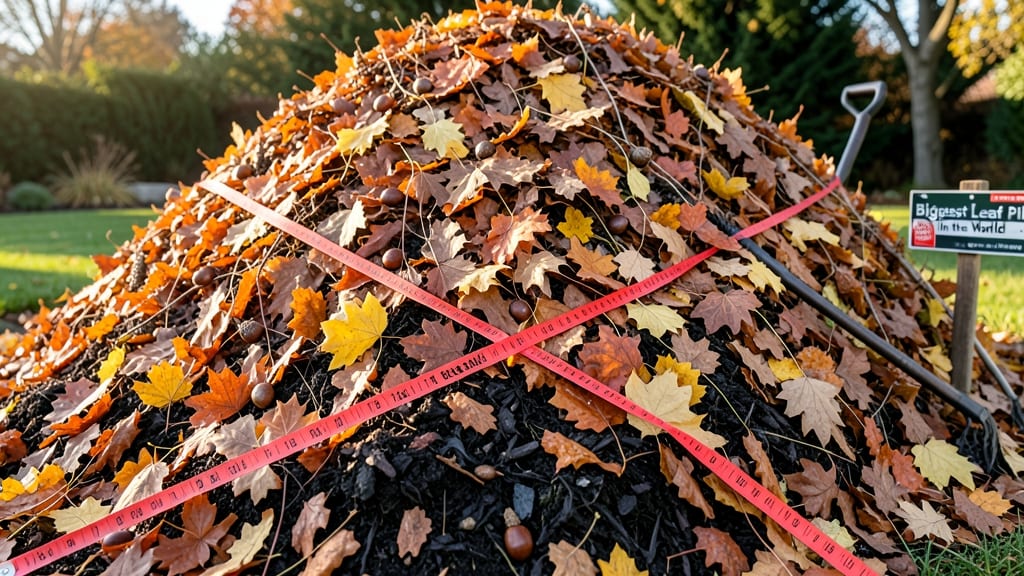
The biggest leaf pile in the world was created in 2018 in New Jersey, USA, by the Morris Township Parks Department, reaching 1,750 cubic feet using 10,000+ maple leaves raked from a 10-acre park. It was certified by Guinness World Records after precise measurements and documentation.
The record-breaking leaf pile wasn't just about size—it was a carefully planned autumn spectacle. 🍂 The Morris Township Parks Department chose maple leaves specifically for their vibrant color and durability, which helped create a visually impressive mound that could withstand wind and weight.
This wasn't just a random pile; volunteers worked for days to rake, stack, and compact the leaves into a precise pyramid shape, with measurements taken at multiple points to ensure accuracy.
What's fascinating is how they used both traditional measuring tapes and advanced laser technology to verify the 1,750 cubic feet volume, making it an official Guinness World Record.
Creating something this massive required more than just leaves—it needed teamwork and timing. The event drew hundreds of participants who helped rake and stack, turning an ordinary park into a fall festival hub.
Safety was a priority too, as wind resistance and uneven weight distribution could have caused the pile to collapse. The perfect timing during peak fall foliage ensured the leaves were dry enough to hold their shape while still vibrant enough to create that iconic autumnal display.
💡 In This Article
- How the Record-Breaking Leaf Pile Was Measured and Validated
- Tips for Creating Your Own Giant Leaf Pile
How the record-breaking leaf pile was measured and validated
To achieve Guinness World Records certification, the Morris Township team employed a multi-step measurement process that combined traditional and high-tech methods. The team first used a laser measuring device to scan the pile's dimensions at 12 evenly spaced points around its circumference, ensuring accuracy despite the irregular shape.
Each scan created a 3D digital profile that allowed them to calculate the average height, width, and depth with millimeter precision. 🔥
The volume calculation itself required converting these measurements into cubic feet using the formula for an irregular pyramid: V = (1/3) × base area × height.
Maple leaves were chosen because their thin, flat structure allowed for tighter packing (about 1.5 cubic feet per 100 leaves) compared to thicker oak leaves, which would have required more space.
The team also compacted the pile in layers, similar to how snow is packed for snowman contests, to maximize density.
Guinness World Records verification involved three independent observers using separate measurement tools to cross-check the results. Each observer took measurements at different times of day to account for potential settling or wind shifts.
The final volume of 1,750 cubic feet was only certified after all three sets of data matched within a 2% margin of error. This rigorous process ensures no record is set by chance—every measurement must be scientifically defensible. 💫
What makes this record particularly impressive is the scale of preparation. The team calculated they needed 10,000+ leaves per cubic foot, meaning the entire pile required over 17.5 million individual leaves.
They mapped out the park's leaf collection zones, assigning volunteers to specific 2-acre sections with GPS coordinates to ensure even coverage. The maple leaves were harvested at peak color (mid-October) when their moisture content was optimal—too dry and they'd crumble, too wet and they'd mold.
Beyond the numbers, the team had to account for environmental factors like wind resistance. Strong gusts could disperse loose leaves, so they used windbreak barriers and compacted the pile in 1-foot layers, tamping each layer like soil in construction.
The final structure resembled a 12-foot-tall pyramid with a 30-foot diameter base, requiring 200+ cubic yards of leaves—enough to fill 15 standard dump trucks. Every detail mattered, from leaf type to compaction technique, to create a pile that was both massive and stable. ✨
Interestingly, the team also documented the leaf-to-leaf friction coefficient, which determined how well the pile would hold its shape. Maple leaves, with their serrated edges, interlock better than smooth leaves like sycamore, creating a self-supporting structure.
This scientific approach turned what might seem like child's play into a precise engineering challenge, blending autumn traditions with measurable science. 🌟
The certification process itself took 6 weeks from initial submission to final approval, including photo documentation, witness statements, and environmental reports. Guinness required proof that the leaves were naturally fallen (not artificially dyed or treated) and that the pile was accessible to the public for verification.
The team even provided time-lapse videos showing the pile's construction, which helped demonstrate the scale and effort involved. 💛